The Language Learner's Dilemma: When Words Don't Mean What You Think They Mean
Learning vocabulary seems simple until you find out that most words don't have a clean one-to-one translation. Even basic words behave differently from one language to the next. For me, this is usually what makes me hesitate before speaking in a new language. I know the word, but I am not sure it fits the sentence.
One word, several jobs
Most dictionaries and apps give you a translation and stop there. The context is what actually tells you whether the word works.
Take the Spanish verb "encender." A dictionary will say it means "to turn on," and that is right for "encender la luz" (turn on the light). But "encender un fuego" is to start a fire, "encender la pasión" is to ignite passion, and "encender un debate" is to spark a debate. Translate any of those as "turn on" and it sounds strange.
"Tomar" is another one. "Tomar un café" is to have a coffee, "tomar un taxi" is to take a taxi, "tomar una foto" is to take a photo, and "tomar una decisión" is to make a decision. Without examples, you would have no good way to know when to use "tomar" instead of "beber" or "hacer."
English is no easier for people learning it. "Get" can mean to buy or fetch ("I need to get milk"), to understand ("I get your point"), to become ("she gets nervous"), and it even forms a kind of passive ("the cake got eaten").
Usage examples in StoryTime Language
To help with this, I added a Word Usage Examples feature to StoryTime Language. Tap a word you have saved to your vocabulary, choose Show Usage Examples, and you get several sentences that use it in different ways. Each one has the sentence in your target language, a translation that shows how the meaning shifts, a short note on usage, and a difficulty level.
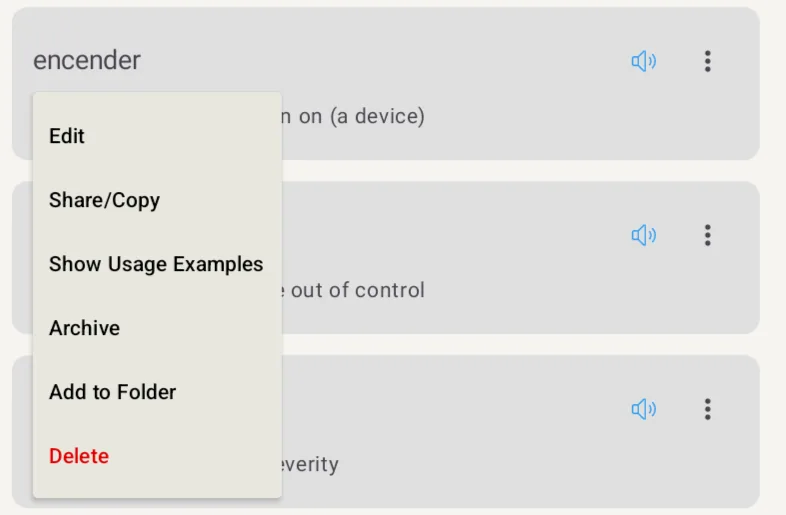
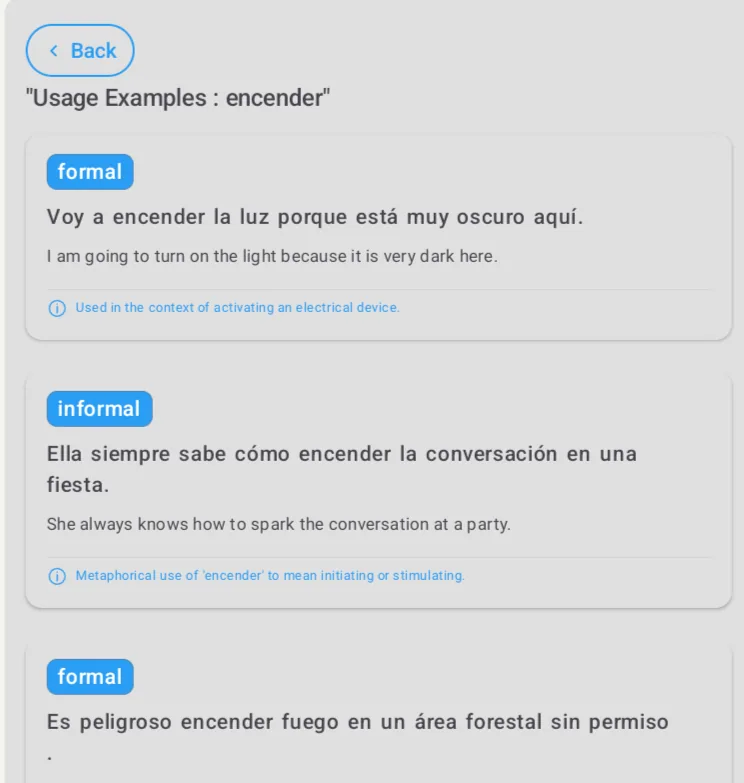
The idea is simple. When a word has more than one meaning, look at how it is used before you guess. After a few examples you start to get a feel for it, and that feel is what lets you use the word without second-guessing yourself.
StoryTime Language is on Google Play. If you have a word that never seems to translate the way you expect, email me at storytimelanguageapp@gmail.com. I would like to hear about it.
Share this article
Related Articles
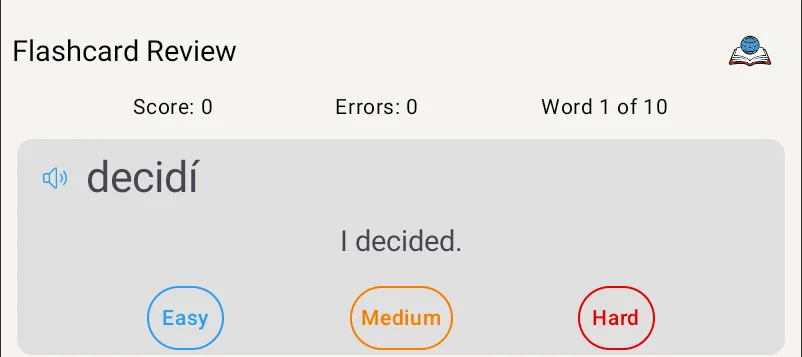
Building Vocabulary Through Recognition to Recall: A Progressive Approach
Understanding a word and being able to say it are two different skills, and the vocabulary games in StoryTime Language are ordered to take you from one to the other.
How to Create Language-Learning Story Prompts That Match Your Needs
How to write a story prompt in your own language so StoryTime Language gives you a story built around a situation you will actually face, at your level.
Why Reading Stories is the Secret to Language Learning Success
Word lists did not get me talking in Japanese, and reading stories at my level is what finally made new words stick.